Optum AI: Healthcare Foundation Models and Clinical GenAI Evaluation
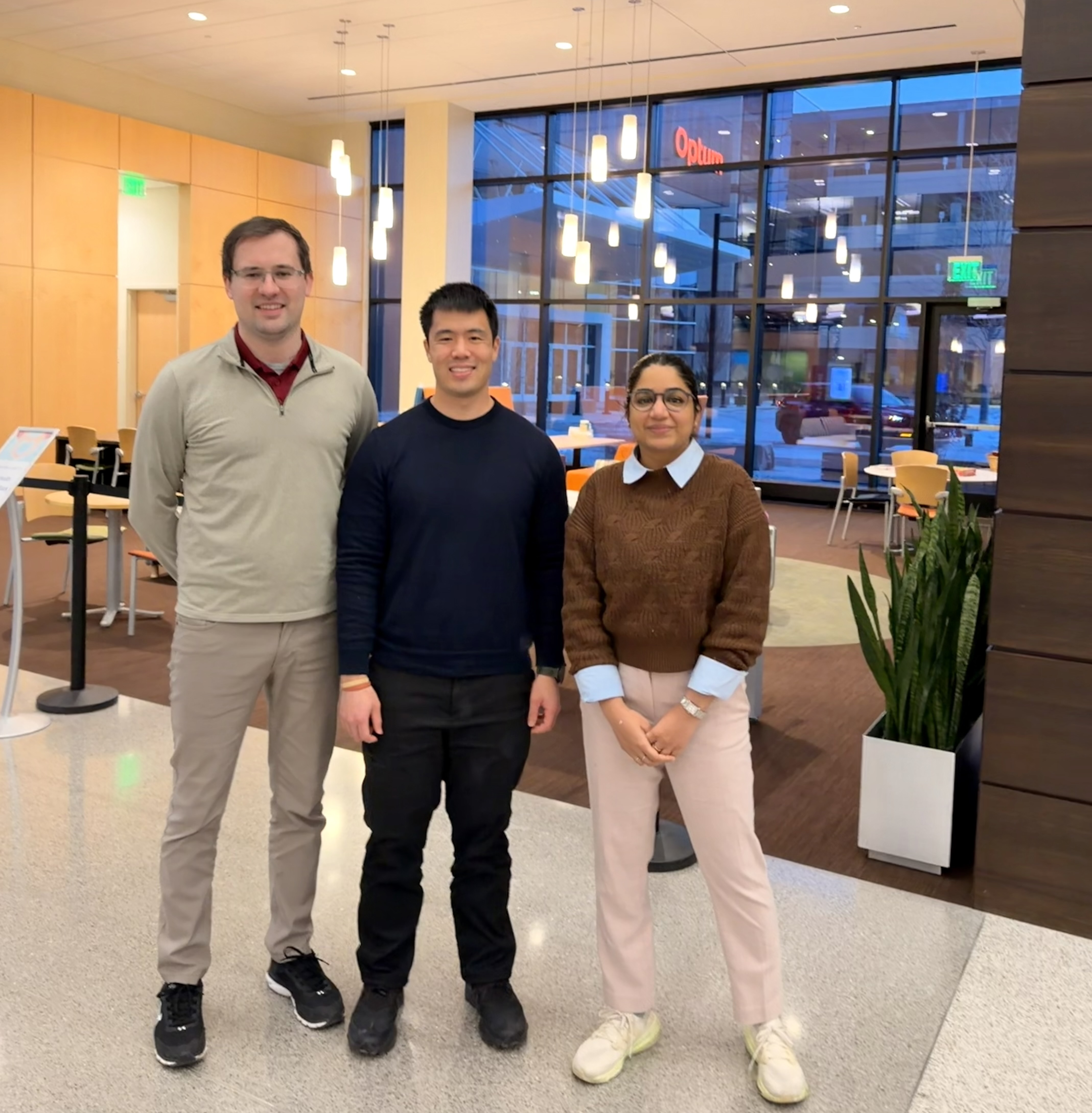
Key Points, TLDR:
- I work at Optum AI as a Senior AI/ML Applied Scientist focused on healthcare foundation models, clinical generative artificial intelligence (GenAI) evaluation, and responsible AI review.
- My foundation model work includes structured electronic health record (EHR) and Current Procedural Terminology (CPT) sequence modeling for healthcare service recommendation and member service discovery.
- My evaluation work focuses on governed evaluation, large language model (LLM)-as-judge metrics, calibrated subject matter expert (SME) review, adversarial prompts, monitoring dashboards, and AI review workflows.
- Across these projects, the common thread is translating applied machine learning research into healthcare products that are useful, measurable, and easier to evaluate responsibly.
Overview
Healthcare artificial intelligence (AI) is moving from isolated model demos into product experiences where reliability, measurement, and governance matter as much as raw model performance. This is especially true in health care, where a model may be technically interesting but still needs to be understandable, measurable, and aligned with clinical and operational constraints before it can be useful. At Optum AI, I work on that bridge between applied machine learning research and real healthcare products.
My role spans model development, evaluation design, stakeholder alignment, and translation of AI capabilities into tools that support healthcare delivery and healthcare navigation. Much of my recent work has centered on longitudinal healthcare modeling, clinical generative artificial intelligence (GenAI) evaluation, responsible AI review, and the evaluation frameworks needed to assess these systems carefully. In other words, I work both on building healthcare AI models and on creating the evidence needed to understand whether those models are behaving in useful and reliable ways.
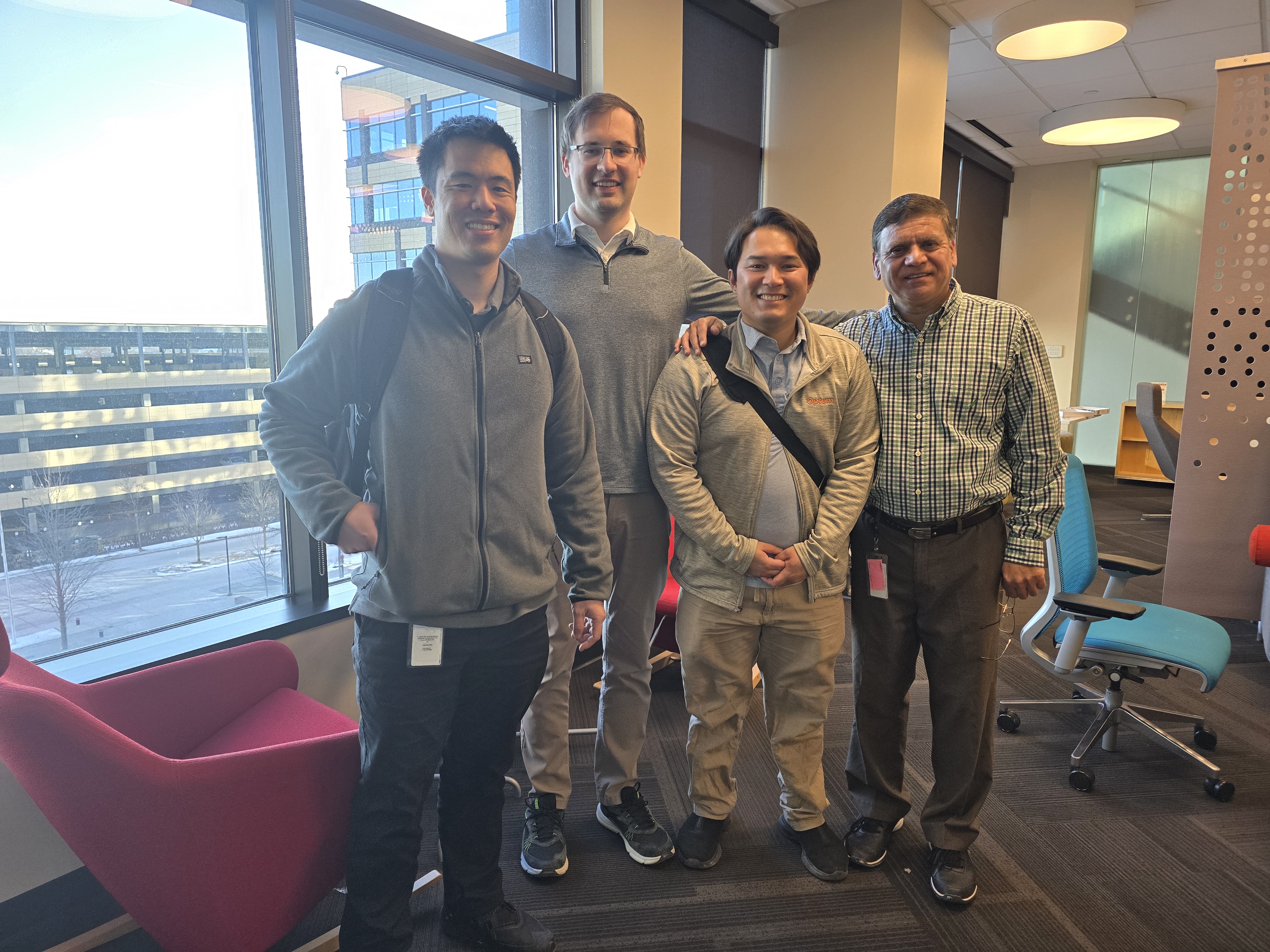
One of the best parts of the work is partnering closely with the broader team across research, engineering, product, and clinical stakeholders.
Healthcare Foundation Model Work
One of the most meaningful projects I have worked on at Optum AI has been a healthcare foundation model for longitudinal care prediction. The underlying idea was to treat a member’s care history as a sequence modeling problem. Instead of words in a sentence, the sequence is composed of healthcare service codes, including Current Procedural Terminology (CPT) codes used to describe medical services and procedures. By training a LLaMA-style autoregressive Transformer architecture on a custom healthcare vocabulary and tokenizer, we built a model that can learn patterns in how care unfolds over time and use those patterns to predict what services may be relevant next.
This line of work connects to SparseEHR, a scalable foundation modeling approach for structured electronic health record (EHR) and healthcare service data accepted to the International Conference on Machine Learning (ICML) 2026 Workshop on Spurious Dynamics for Health. In other words, the same modeling family that people often associate with language modeling can also be adapted to structured healthcare sequences, where the goal is to learn useful representations of longitudinal care patterns rather than natural language alone.
This work became the core engine behind a production recommendation experience. In practice, the model helps surface care-path suggestions that are contextually related to what a member is currently exploring and what similar members have historically used in their plan journey. The training and evaluation work used large-scale healthcare service patterns across millions of members, with the product goal of improving healthcare service discovery and making adjacent planning options easier to find.
The public Optum / UnitedHealthcare press coverage for this product experience can be found here:
How It Works in Product
The screenshots below show one example of how the recommendation flow appears in the mobile experience.
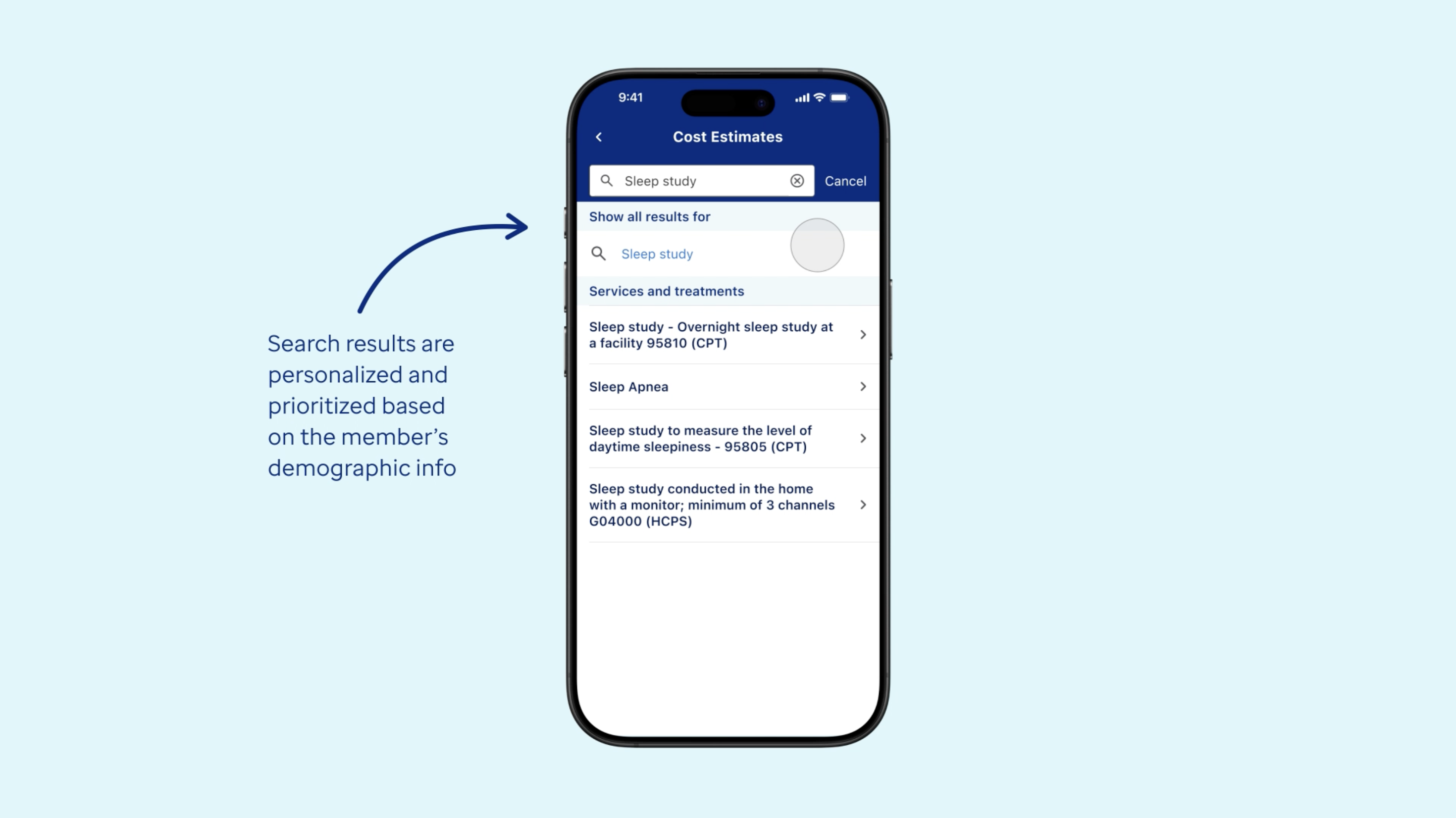
A member begins by searching for a service. In this example, the search is for a sleep study, and the ranked results include options related to sleep apnea and overnight sleep studies.
Once the member selects a relevant result such as Sleep apnea or a related sleep study option, they arrive at the cost estimate page. From there, the product can surface a section called Members also used their plan for. That recommendation strip is where my model is serving personalized adjacent suggestions based on learned patterns in longitudinal care sequences.
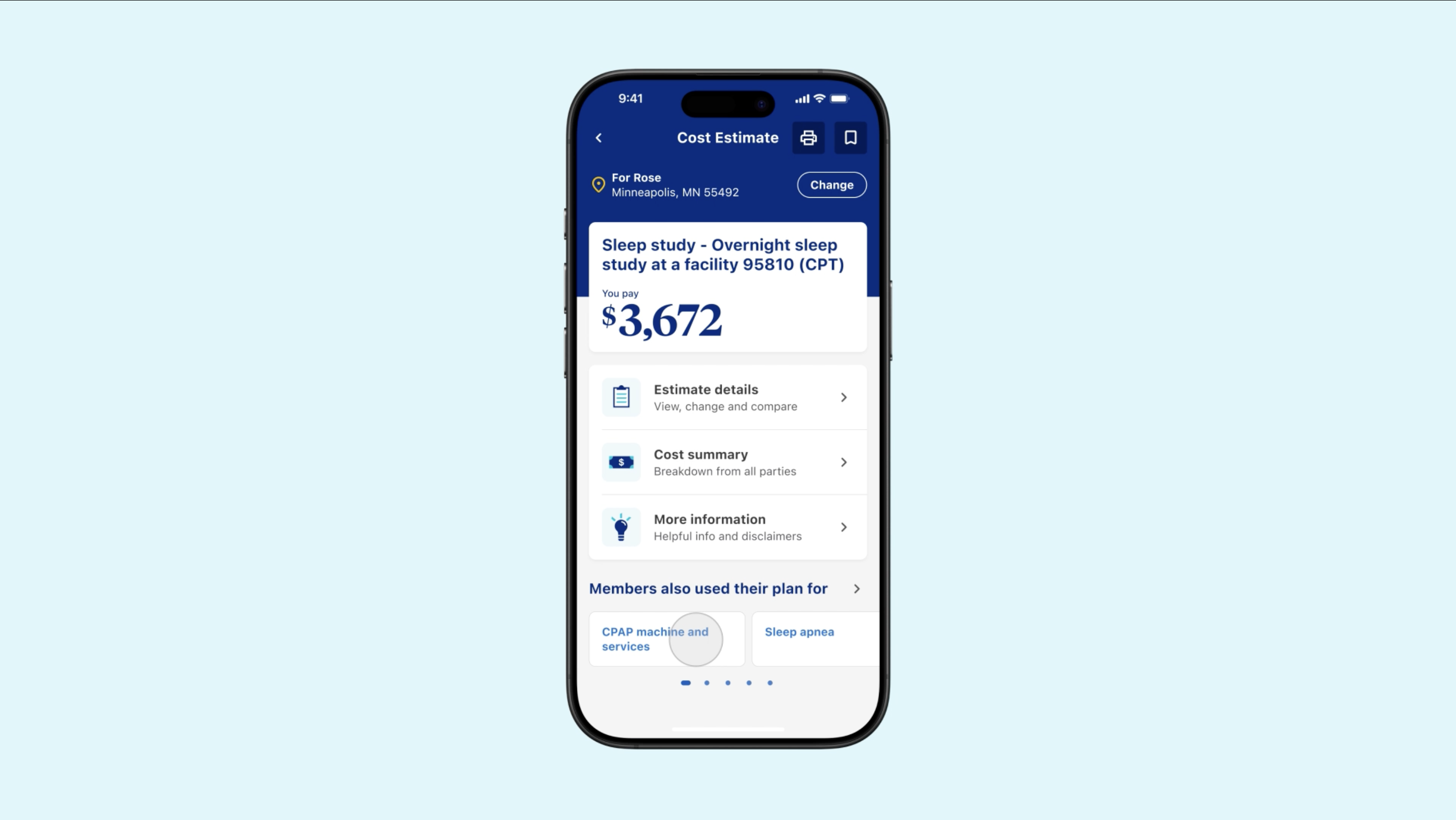
After the member lands on the service page, the recommendation shelf appears under Members also used their plan for. In this example, the model surfaces related care-path options such as CPAP machine and services and Sleep apnea.
If the member taps one of those suggestions, such as CPAP machine and services, they are taken directly to a related cost estimate experience for that downstream service.
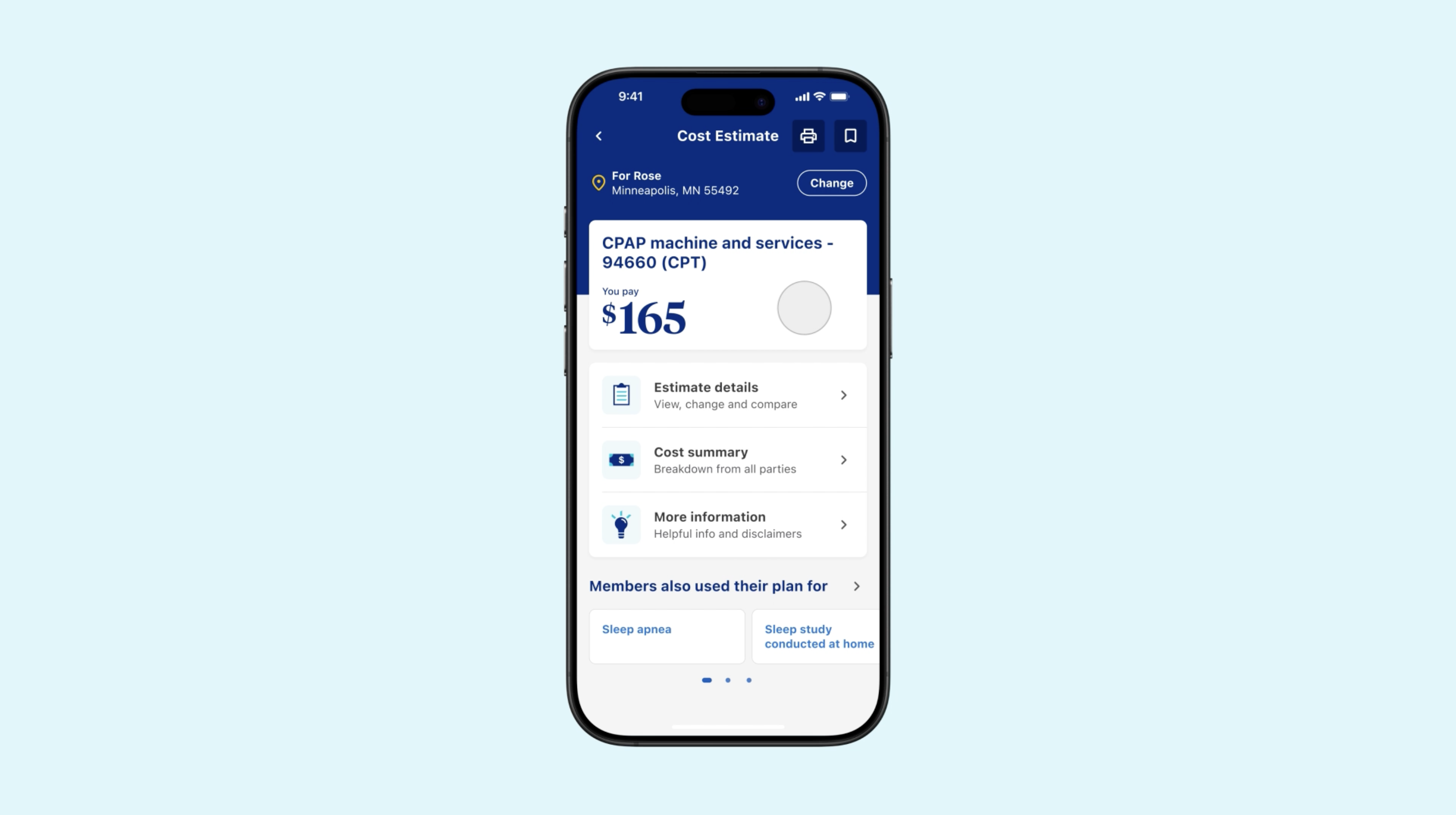
This is the downstream recommendation in action: the member selects a related suggestion and moves into another relevant estimate and planning experience.
For me, this project is a strong example of what makes health AI exciting: a relatively abstract machine learning idea can be turned into a concrete member-facing feature that improves navigation, supports decision making, and operates within a real healthcare product. However, the technical model is only one part of the story. The surrounding work also includes interpretation, product alignment, model monitoring, and clear communication about what a recommendation system is and is not intended to do.
Clinical GenAI Evaluation and Governance
Another major part of my work at Optum AI is clinical GenAI evaluation. In this context, GenAI refers to models that generate text or transform medical-record-grounded information for clinician-in-the-loop workflows. These systems need more than a generic accuracy score. They need evaluation plans that reflect the use case, the expected failure modes, the review workflow, and the kinds of evidence that subject matter experts (SMEs) need to judge output quality.
I have worked on governed evaluation workflows that combine automated natural language processing (NLP) metrics, large language model (LLM)-as-judge metrics, calibrated SME review, adversarial prompts, and monitoring dashboards. In other words, the goal is not to replace expert review with a single automated score, but to create a repeatable evaluation system that makes model behavior easier to inspect across many examples and over time.
The use cases I have supported include healthcare text generation, chart summarization, medical coding support, expanded response generation, and electronic medical record (EMR) text transformation. I also built reusable evaluation tooling to support review teams as they triage AI systems against policy, best practices, and historical review patterns. This work sits at the intersection of applied machine learning, AI governance, model monitoring, and responsible AI, which is where much of the practical difficulty of health AI lives.
Other Areas of Focus
Beyond the foundation model and clinical GenAI evaluation work, I also spend time on the engineering details that make health AI systems more reliable in practice. This includes building reusable Python evaluation libraries, designing monitoring workflows, translating model outputs into product behavior, and helping research, engineering, product, clinical, and governance stakeholders align on what a system is doing. These skills are less visible than the model architecture itself, but they are often what determine whether an AI system can be evaluated clearly and improved responsibly.
What I Enjoy Most
One of the most rewarding parts of the work is operating at the boundary between technical depth and real-world constraints. Healthcare AI is not just about building a strong model. It also requires clear communication, careful validation, and close partnership with clinicians, product leaders, governance teams, and business stakeholders. I enjoy helping different domain experts get aligned on what a system is doing, how it should be evaluated, and what responsible AI review should look like.
Final Thoughts
My work at Optum AI has reinforced a simple lesson: healthcare AI needs both strong modeling and strong evaluation. Foundation models, recommender systems, LLM-as-judge metrics, monitoring dashboards, and clinical GenAI evaluation are all useful only when they help people understand model behavior and make better decisions about how AI should be used. As health AI continues to mature, I am especially interested in systems that connect rigorous machine learning research with practical evidence, real-world workflow constraints, and measurable value for the people navigating healthcare.